
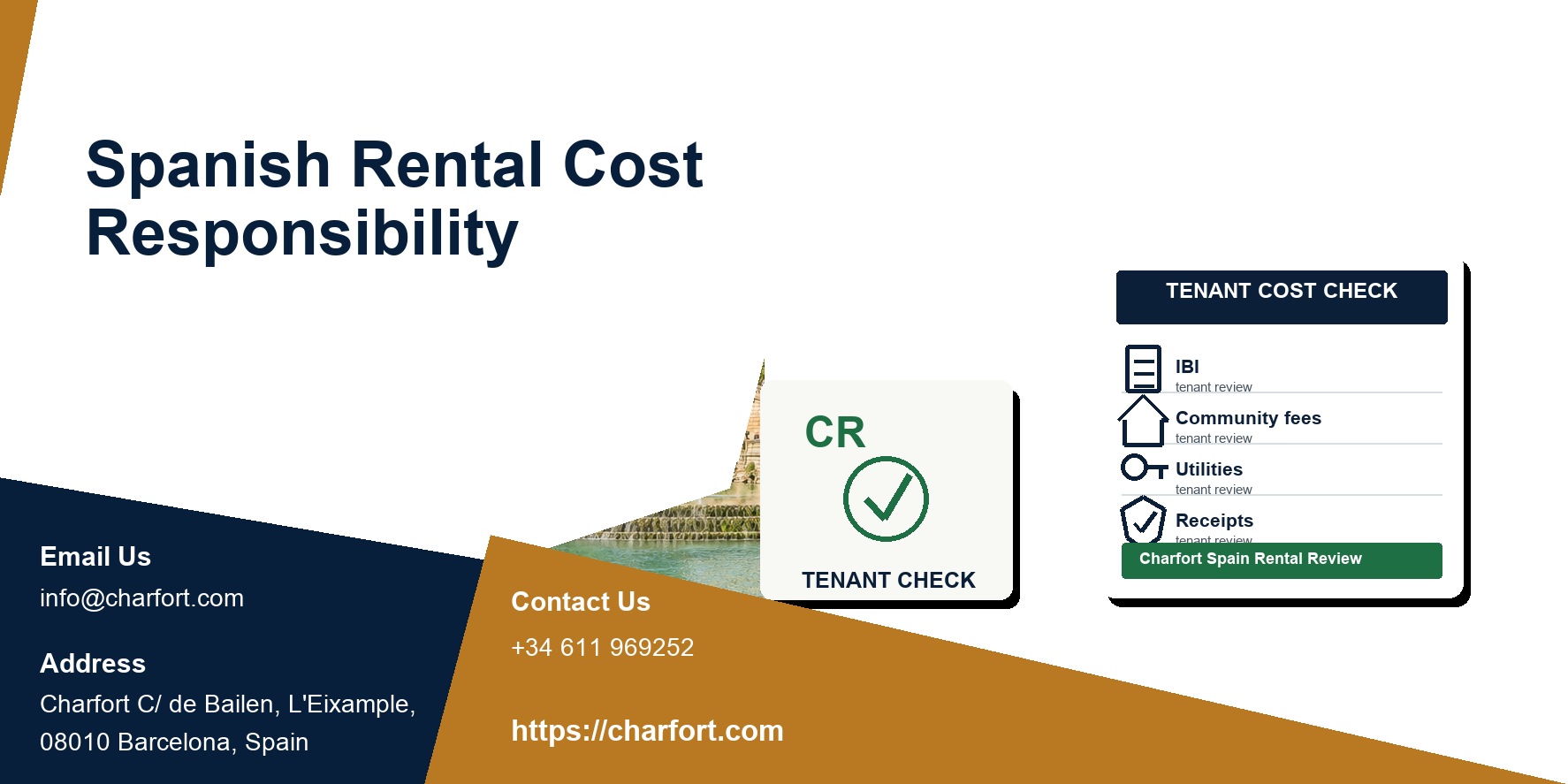
Foreign tenants often compare Spanish listings by monthly rent alone, then discover separate charges for water, electricity, gas, internet, rubbish, community expenses, IBI, repairs, or agency-related costs. Some charges are normal if written clearly. Others need careful review because they can shift owner costs onto a tenant.
The practical question is not only who usually pays. It is whether the charge is legally and contractually allocated, whether the amount is measurable, whether the tenant can see receipts, and whether the cost was disclosed before the tenant committed.
In a Spanish rental, utilities are commonly paid by the tenant when they relate to actual consumption, while IBI and ordinary community-owner costs normally belong economically to the owner unless the contract validly allocates a permitted cost to the tenant. The contract should identify each expense clearly before signing.
What to Know Before You Commit
This topic belongs to the Foreign Tenant Experience cluster. That matters because the reader’s job is specific. A tenant is trying to protect their housing, payments, documents, and relocation timeline. A landlord is trying to protect the property, comply with legal and tax obligations, delegate work safely, and keep records. Mixing those user states creates vague advice. This article stays inside the correct side of the rental relationship and links to the other side only where the practical file overlaps.
The safest approach is to treat the issue as a document-and-evidence question. Verbal explanations may be friendly, but rent, tax, repair, deposit, registration, management, and payment disputes are resolved through written records. The useful file normally includes the contract, annexes, receipts, invoices, photographs, messages, authority evidence, and current official-source checks where law or tax is involved.
Responsibility and Risk Table
| Cost | Usual tenant question | What to verify | Red flag |
|---|---|---|---|
| Utilities | Am I paying actual consumption or a fixed estimate? | Meter readings, contract holder, billing period, tariff, and handover reading. | Tenant pays old consumption from before move-in. |
| IBI | Is the landlord trying to pass local property tax to me? | Contract wording, annual amount, disclosure before signing, and whether the charge is permitted in context. | IBI appears after signing or is described only verbally. |
| Community fees | Are these owner community expenses or services consumed by the tenant? | Lease clause, community fee description, service element, and invoice evidence. | Tenant pays broad owner fees without knowing what they cover. |
| Rubbish or municipal charges | Is there a local charge linked to occupation? | Municipal practice, invoice, contract clause, and who is legally billed. | Charge is bundled with unclear admin cost. |
| Internet and optional services | Is it included in rent or separate? | Provider, speed, contract holder, cancellation rules, and equipment return. | Listing says included but contract says tenant pays. |
Evidence to Prepare
Use the following checks before signing, paying, delegating authority, or relying on the arrangement:
- List every amount due at signing, monthly, annually, and at move-out.
- Ask whether each amount is rent, consumption, owner cost, tax, service, or reimbursable expense.
- Request sample bills or the previous annual amount where a recurring cost is passed on.
- Record meter readings at check-in and check-out with photographs.
- Make sure the contract matches the listing and any agent messages about included costs.
The list should not be treated as a generic formality. Each item answers a practical question: who is responsible, what evidence proves it, when does the obligation arise, and what happens if the other party disagrees. If an item cannot be evidenced, decide whether it should be clarified, negotiated, reviewed professionally, or rejected before the commitment becomes expensive.
Practical Workflow
- Start with the monthly rent and ask what is included.
- Separate utilities based on actual consumption from fixed owner charges such as IBI or community fees.
- Ask for written wording before accepting any non-rent charge.
- Compare the amount with evidence, not only the landlord’s estimate.
- Keep receipts and meter readings with the tenancy file.
This workflow gives the page its practical value. It keeps the decision in sequence instead of letting urgency decide the outcome. A rushed tenant may pay before verifying authority. A rushed landlord may accept a tenant before the property file is ready. A rushed non-resident owner may rent successfully but lose tax evidence. Slowing the process at the right point is usually cheaper than repairing a weak file later.
Decision Framework
Use a three-part decision before moving forward. First, ask whether the issue is clear enough to accept. That means the parties, property, amount, document, authority, timing, and responsibility are all written down and consistent with the real use of the property. If the answer is yes, the file can usually move forward with ordinary caution.
Second, ask whether the issue is acceptable only after clarification. This is common in Spanish rentals. A landlord may need to explain a cost. A tenant may need proof that registration is possible. A manager may need a repair-approval limit. A non-resident owner may need a tax adviser to confirm the filing route. Clarification should produce a document, receipt, revised clause, invoice, or written instruction. If the answer remains only verbal, the risk has not really moved.
Third, ask whether the issue should pause the transaction. Pause where the other party cannot show authority, the payment recipient is unclear, the contract label does not match the real use, a tax or municipal point is essential but unverified, or a management agreement gives broad control without reporting. Pausing is not the same as refusing. It is a controlled stop so the file can catch up with the decision.
Documents and Records to Keep
For this topic, the useful evidence file normally includes four types of records. Keep identity and authority records so it is clear who can sign, receive money, give instructions, approve repairs, or represent the owner. Keep contract records so the agreed rental type, payment terms, duration, obligations, and notices are traceable. Keep money records so rent, deposits, guarantees, taxes, utilities, management fees, and expenses can be reconciled. Keep condition and communication records so repairs, inventory, handover, and disputes can be understood later.
The file does not need to be complicated. A well-named folder with the signed contract, annexes, receipts, invoices, photos, meter readings, emails, and professional comments is often enough. The point is to avoid rebuilding the story from scattered WhatsApp messages or bank transfers after a disagreement appears. For non-resident owners, the same file also supports tax review and property-management oversight.
Common Red Flags
- A tenant may accept a property because the rent looks competitive, then pay extra owner costs that make the total expensive.
- A contract may say the tenant pays all expenses without explaining which expenses are included.
- Utility contracts may remain in the landlord’s name, making consumption and debt harder to track.
- Annual costs may arrive after the tenant has lost negotiating leverage.
Red flags are not automatic deal-breakers. They are signals that the file is not ready. The right response may be a written clarification, a revised clause, a receipt, a professional review, or a decision to walk away. The important point is to identify the risk while the reader still has leverage.
Practical Scenario
Assume a tenant signs for a flat in Valencia at a rent that seems fair. Before signing, the agent says utilities are separate and community fees are small. The final contract says the tenant pays IBI, community fees, rubbish, water, electricity, gas, internet, and any service connected to occupation. That wording should be paused and clarified. The tenant needs amounts, invoices, meter readings, and a clear distinction between owner costs and tenant consumption.
This example is simplified and should not be used as a guaranteed legal or tax result. It shows how the issue normally appears in a real rental file: one missing clause, one unclear payment, one unverified authority, or one unmanaged tax record can affect several later decisions.
How This Connects to the Rental Cluster
This tenant-cost page sits below renting property in Spain as a foreigner. It should be reviewed with the Spanish rental contract checklist, rental deposits and guarantees guide, and repair responsibility guide.
The connection is intentionally narrow. Tenant-side pages support tenant onboarding, protection, and relocation risk prevention. Landlord-side pages support owner compliance, management setup, and rental-operation risk control. The site can link both ecosystems without merging them into one broad Spanish rentals article.
When Professional Support Helps
Charfort can help foreign tenants compare the real cost of a Spanish rental and flag unclear expense clauses through Spain rental assistance.
Professional support is especially useful where the contract is Spanish-only, the owner is abroad, the tenant has relocation deadlines, the property is furnished, a company is involved, tax residence is unclear, or someone is being asked to transfer money before the evidence file is complete.
This article provides general information and does not replace advice based on personal, legal, tax, immigration, or financial circumstances.
FAQs
Does the tenant pay IBI in Spain?
IBI is a local property tax linked to ownership. A landlord may try to allocate some costs by contract, but the tenant should check whether the clause is valid, clear, disclosed, and commercially acceptable.
Are community fees included in rent?
Often they are economically an owner cost, but contracts vary. Tenants should ask whether community fees are included and whether any service component is separately charged.
Who pays electricity and water?
Tenants commonly pay their actual consumption. Meter readings at check-in and check-out are essential.
Can a landlord add costs after signing?
New charges are difficult to evaluate without contract wording. Tenants should resist surprises and ask for written basis and receipts.
Should I transfer utilities into my name?
It can be useful, but practical steps depend on landlord agreement, supplier rules, deposit, and the length of tenancy.
What should I check before paying annual costs?
Ask for the invoice, period covered, contractual clause, and calculation showing why the tenant is responsible.
Sources and Review Note
Last reviewed: 30 June 2026. Spanish rental, tax, municipal, and property-management rules can depend on contract date, autonomous community, municipality, rental type, owner residence, tenant use, and individual facts. Current official sources used for this article include: