
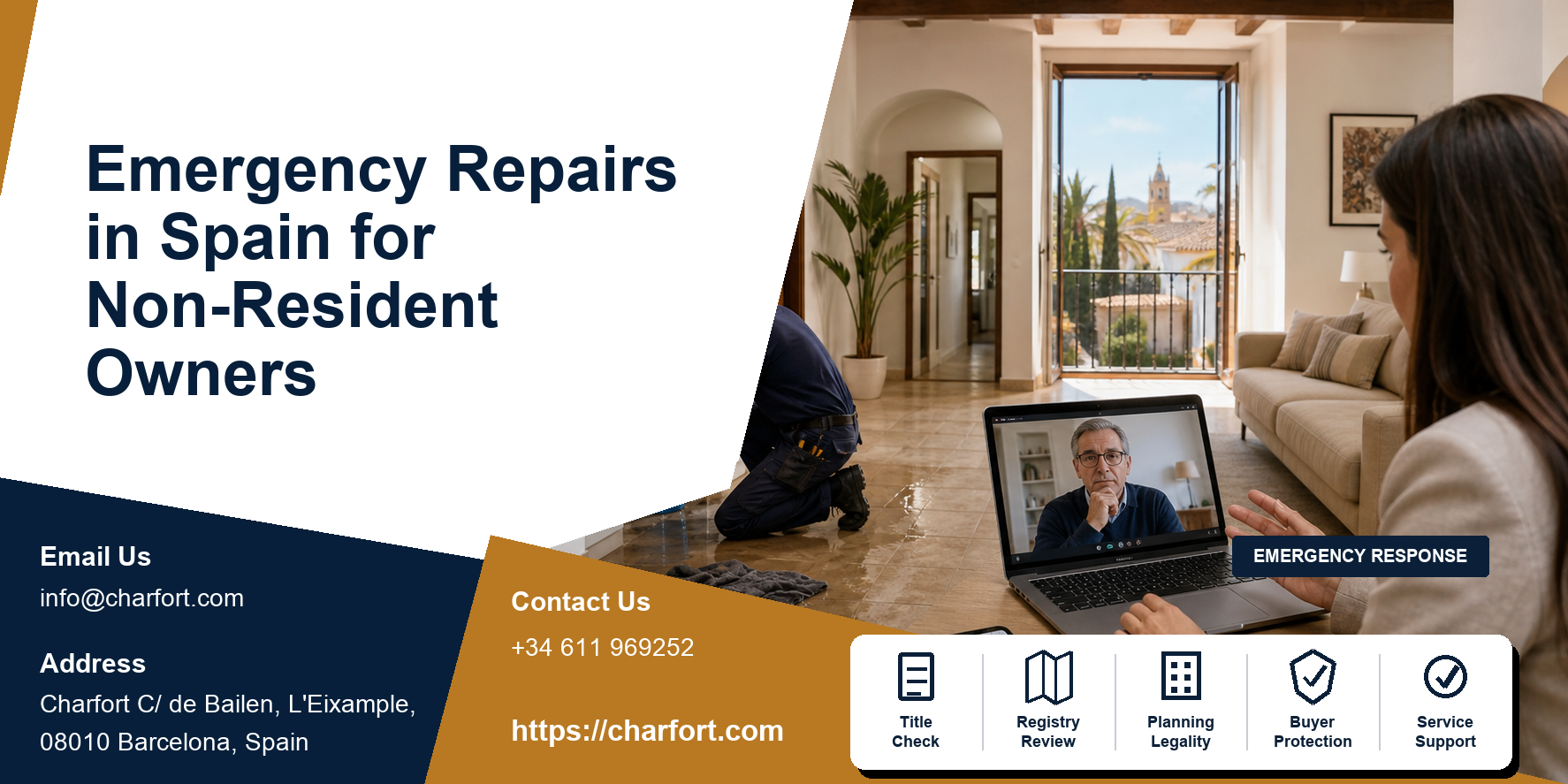
A property emergency is defined first by danger and continuing damage, not by whether a contractor calls the job urgent. Water escaping, electrical overheating, gas odour, fire, forced entry and storm damage require different first actions. A non-resident owner needs someone who can verify the facts physically and contact the correct service.
The response should preserve safety, stop avoidable damage and retain evidence without authorising an uncontrolled renovation. The local contact needs pre-agreed authority and spending limits, while the owner needs one communication channel that records decisions and invoices.
For immediate danger, call Spain’s emergency services on 112. Otherwise verify the incident, protect people, isolate water or electricity only where safe and competent, contact the community or utility when shared infrastructure is involved, notify the insurer as required, document the condition and authorise only stabilisation within written limits. Obtain diagnosis and a scoped quotation before permanent work.
The focus here is the remote emergency workflow. Preventive planning is covered in Maintaining a Property in Spain, insured-risk selection in Home Insurance for Foreign Owners, and tenant-versus-landlord liability in Spanish rental repair responsibilities.
Put Safety Before Property and Cost
Fire, gas, electrocution, collapse, flooding and personal danger require emergency services or the relevant utility, not a general handyman. The person attending should not enter an unsafe area. The owner should know the property address, access details and any vulnerable occupants so accurate information can be passed quickly.
Where there is no immediate danger, stop the damaging source only if the attending person can do so safely. A known water isolation valve may be used under instructions; opening electrical equipment or handling gas should be left to competent professionals.
Identify Who Controls the Affected System
A leak can originate in the private unit, another property or a common pipe. An electricity failure may be internal, building-wide or network-related. Ask the local contact to gather location, meter, neighbour and community information before appointing the wrong contractor.
Notify the community administrator promptly for common roofs, façades, shared pipes, lifts or building services. Contact the supplier or distributor for network and metering issues. This does not prevent temporary safety action, but it helps preserve responsibility and access.
Separate Stabilisation From Permanent Repair
Emergency stabilisation may include isolating water, boarding a damaged opening, extracting standing water or making a system safe. Permanent repair should follow diagnosis, permission and a written scope. The company performing emergency attendance should not receive automatic authority for every later work item.
Use a spending ceiling and require photographs before and after stabilisation. If cost must exceed the ceiling, obtain owner approval unless immediate action is necessary to protect life or prevent clearly disproportionate damage under the documented authority.
Protect Insurance and Evidence
Notify the insurer according to the policy and applicable law, describe what is known and avoid unsupported conclusions about cause. Photograph the source area, spread, damaged contents and emergency work. Preserve replaced parts where reasonable and retain call logs, invoices and reports.
After stabilisation, arrange technical diagnosis, drying or security review as appropriate. Confirm that the incident has not created hidden moisture, unsafe wiring or an unresolved access vulnerability. Close the file only when follow-up actions and responsibility are recorded.
First-Hour Emergency Response
Use this table to separate routine action from the point at which the owner should obtain provider, community, technical or legal confirmation.
| Owner decision | Practical control | Escalate when |
|---|---|---|
| Danger to people | Call 112 and keep people away | Fire, gas, shock, collapse or serious flooding |
| Active private leak | Isolate safely, document and call qualified plumber | Concealed source or damage beyond the unit |
| Possible common leak | Notify administrator and affected neighbours | Roof, façade or shared pipe is suspected |
| Electrical failure | Stop unsafe use and contact qualified provider | Heat, smoke, shock or repeated trip |
| Forced entry | Contact police, secure evidence and insurer | Entry remains unsafe or occupation is suspected |
| Storm damage | Avoid unsafe access and stabilise when authorised | Structure, public risk or common element is affected |
Record the decision, date, responsible person and supporting document. A recurring ownership task is easier to manage when the next review point is visible rather than held in one person’s memory.
Apply the Guidance to Your Property
Start with the facts of the actual home rather than a generic Spain-wide assumption. Record the autonomous community and municipality, property type, age, construction, current use, normal vacancy period, community setting and any relevant renovation or incident history. Apartment owners should identify which systems and surfaces are private and which are common. Detached-home owners should include boundaries, roofs, drainage, external equipment and access. These facts determine which part of the guidance requires provider, community, technical or legal confirmation.
Use current written evidence whenever the decision can affect safety, legality, insurance, cost or later sale. That may include a contract, policy schedule, municipal response, community resolution, technical report, meter record, dated photograph, invoice or professional advice. A verbal explanation can help identify the next question, but it should not be treated as final authority where a document or formal confirmation should exist. Keep the evidence with the property reference and decision date so another authorised person can understand it without reconstructing the conversation.
When quotations or service proposals are required, give each provider the same property information and scope. Compare identity, responsibility, exclusions, timing, access, insurance, taxes, additional services, cancellation and the evidence delivered at completion, not only the headline price. If the offers are materially different, first test whether they are pricing the same work. A cheap proposal that omits a permit, inspection, regulated specialist, emergency response or close-out document may expose the owner to a larger later cost.
Finally, decide who will perform the action, who may approve changes, who verifies completion and when the next review occurs. The level of control should be proportionate: a routine account check does not need the same governance as structural work or a suspected security incident. Even so, every recurring task benefits from a named person, a due date, a completion record and a clear escalation point. This approach lets an overseas owner delegate practical work while retaining informed control of the property.
How to Handle Emergency Repairs For Non-Resident Owners In Spain
A foreign owner can use the following sequence to keep the task controlled:
- Classify immediate danger and call 112 where required.
- Send the authorised local contact or appropriate emergency provider.
- Protect people and isolate the damaging source only where safe.
- Identify private, common, neighbour or utility responsibility.
- Photograph and record the condition before non-essential work.
- Notify insurer, community, police or supplier as applicable.
- Authorise stabilisation under the agreed spending limit.
- Obtain diagnosis, permanent scope and closure evidence.
The sequence should be adapted to the property and locality. Urgent safety, water, fire, security or legal issues should be escalated immediately rather than waiting for the next scheduled review.
Owner Checklist and Records
Keep the following information available to the owner and any authorised local contact:
- Exact property address, access route and occupant information.
- Water, electricity and gas isolation locations.
- Local key holder and backup contact.
- Community administrator and utility emergency contacts.
- Insurance policy and claims number.
- Approved emergency providers and spending limits.
- Incident photographs, reports, invoices and decision log.
Store current working copies securely and keep irreplaceable originals protected. Access should be limited to the people who need the information for the authorised task.
Risks and Decision Points
The following warning signs justify clarification, a second quotation or professional review:
- A handyman is sent to a gas, fire or structural danger.
- The owner authorises a complete repair before cause and responsibility are known.
- Common elements are altered without community involvement.
- Evidence is removed before the insurer or technician can assess it.
- The only key holder is unavailable.
- Temporary drying or boarding is treated as final closure.
A pause is usually less expensive than correcting unauthorised work, uninsured damage, an avoidable service interruption or a decision made without the community or municipality.
Foreign-Owner Scenario
A US owner receives a water-leak alert from a vacant Madrid apartment. The local contact enters, sees water from the ceiling and notifies the upstairs neighbour and administrator rather than opening the ceiling immediately. Water is isolated in the source apartment, photographs and meter details are captured, and both insurers are notified. Emergency extraction limits damage. Permanent ceiling work waits until the source repair and drying are confirmed.
The scenario is illustrative. The correct action can depend on the autonomous community, municipality, building, community rules, property type, insurer, service contract and the owner’s personal circumstances.
Continue the Ownership Journey
Prepare for incidents through Maintaining a Property in Spain, Home Insurance and Managing Property from Abroad. Where an alarm or forced entry is involved, continue to Property Security While Living Abroad; where water persists, use damp and water-damage prevention.
How Charfort Can Help
Charfort can help owners establish local access, reporting and professional coordination before an incident and support communication during the ownership response through its Spain property coordination service.
Charfort can coordinate ownership information and professional work, but it does not replace a property lawyer, architect, technical architect, engineer, insurer, security company, utility provider, tax adviser or emergency service.
Official Sources and Review Note
The following primary or official sources were checked for this article. Municipal procedures, provider requirements, insurance terms, community rules and regional programmes can change, so owners should verify the current position for the property.
- Spanish Government: 112 emergency number
- Spanish Official State Gazette: Insurance Contract Law 50/1980
- Spanish Official State Gazette: Horizontal Property Law
- Spanish Civil Protection: flood preparation and self-protection
*Last reviewed 2026-07-29. This article provides general information and does not replace advice based on your personal, legal, technical, tax, insurance or financial circumstances.*
Frequently Asked Questions
What is the emergency number in Spain?
Call 112 for immediate danger requiring emergency services.
Can my key holder authorise repairs?
Yes within clear written authority and limits. Major or permanent work should follow diagnosis and owner approval unless immediate safety action is necessary.
Who handles a leak from a common pipe?
Notify the community administrator and insurer. Responsibility depends on the source and facts.
Should I call the insurer before stopping a leak?
Protect safety and limit damage first, then notify the insurer promptly and preserve evidence.
Can a temporary repair remain in place?
Only until a suitable permanent solution is diagnosed, authorised and completed.
What if I have no local contact?
Use an appropriate emergency provider, community contact or professional manager and establish reliable access as soon as possible.
Conclusion
A remote emergency plan should make the first hour predictable: protect people, identify the system, stop continuing damage, preserve evidence and limit authority to stabilisation. Permanent repair comes after cause, responsibility and scope are understood.