
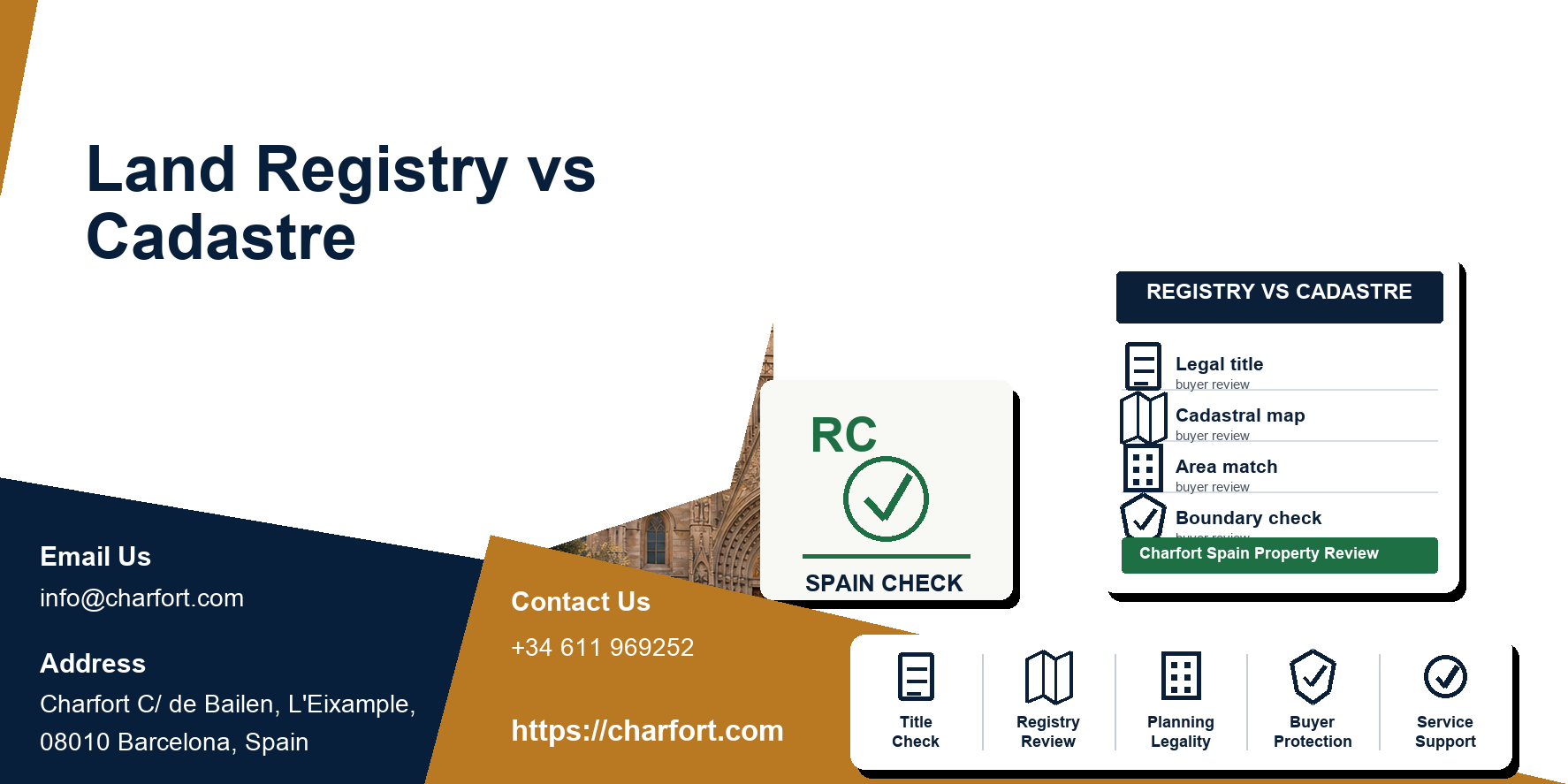
Foreign buyers often ask whether the Land Registry or the Cadastre is the ‘real’ Spanish property record. The answer is that they perform different functions. A safe purchase does not choose one record and ignore the other; it tests whether both records describe the same asset closely enough for the intended purchase.
The Spanish Land Registry mainly protects legal title, ownership and registered rights. The Cadastre mainly records physical, mapping and tax-related property data. Buyers should review both because a property can appear legally registered but still have cadastral, area, boundary or construction discrepancies that affect valuation, financing, tax, planning review, or future resale.
Comparison Between the Land Registry and the Cadastre
| Record | Main function | What it helps prove | Main buyer limitation |
|---|---|---|---|
| Land Registry | Legal registry of ownership and real rights. | Owner, registered title, mortgages, liens, easements, legal annotations, registered description. | May not fully reflect physical reality, renovations, boundaries, or current measured area. |
| Cadastre | Administrative record used for property identification, mapping and taxation. | Cadastral reference, location, map, surface, use, cadastral value data, physical-tax description. | It is not the same as proof of legal ownership or clean title. |
| Coordinated record | A better alignment between legal and cadastral descriptions. | More confidence that the registered property and mapped parcel correspond. | Coordination does not automatically prove planning legality or construction compliance. |
Why Buyers Need Both Records
The Land Registry is usually checked through the Nota Simple. It is central for ownership, charges, and registered legal rights. The Cadastre is checked through the cadastral reference, cadastral certificate, map, and administrative data. In the complete due-diligence checklist, these records sit next to each other because each can reveal a different risk.
A buyer may find that the registry says an apartment has one area while the Cadastre or measured plan says another. A villa may show a pool in aerial imagery but not in registry description. A rural plot may have cadastral boundaries that do not match the fence line. These are not always fatal, but they should not be ignored.
What the Land Registry Is Stronger For
- Confirming the registered owner and ownership percentage.
- Identifying mortgages, embargoes, easements, usufructs, rights of use, or legal annotations.
- Checking whether parking spaces, storage rooms, or annexes are separately registered.
- Understanding the legal description that will be transferred at completion.
- Supporting the notarial and mortgage review process.
What the Cadastre Is Stronger For
- Identifying the cadastral reference used for tax and administrative purposes.
- Reviewing location, maps, parcel boundaries, and built-area data.
- Checking whether cadastral use matches the buyer’s understanding of the property.
- Comparing physical occupation with tax-administrative records.
- Detecting area, construction, boundary, or mapping inconsistencies that need review.
Discrepancies That Matter Most
Not every difference is a crisis. Minor area differences can arise from measurement methods or historic records. Higher-risk discrepancies involve unregistered extensions, buildings that appear in one record but not the other, cadastral boundaries that affect access or land area, and property uses that conflict with planning or community restrictions. For scenario-specific handling, see registry and cadastral discrepancies.
If a discrepancy comes from a renovation, extension, enclosed terrace, annex, or pool, the buyer should also review illegal extensions and unregistered renovations.
Buyer Workflow
- Request the current Nota Simple and cadastral reference.
- Compare owner, address, floor, unit, boundaries, surface area, use, annexes, and built elements.
- Check whether cadastral and registry coordination exists or whether the records diverge.
- Ask the seller to explain discrepancies with deeds, licences, plans, or technical certificates.
- Have a lawyer and, where needed, an architect or surveyor review whether rectification is possible or necessary.
- Use the answer to decide whether to continue, renegotiate, condition the contract, or withdraw.
Why the Records Can Differ Without Either Being Useless
The Land Registry and Cadastre were built for different functions, so a mismatch does not always mean someone has made a serious mistake. Older titles may use historic descriptions. Cadastral mapping may have been updated after aerial review or administrative changes. Built areas may be calculated differently depending on whether common elements, terraces, covered areas or annexes are included.
The buyer’s task is not to demand mathematical perfection in every case. The task is to understand whether the difference affects legal title, value, financing, planning legality or future resale. A small measurement difference in an urban apartment may be acceptable after review. A large mismatch in a villa, rural plot or property with recent works is a different risk category.
How to Build a Comparison File
A useful comparison file normally includes the Nota Simple, title deed, cadastral certificate, cadastral map, floor plan, measured plan where available, IBI receipt, seller explanation and any licences or technical certificates connected to built area. The buyer should compare address, floor, unit number, cadastral reference, surface area, use, boundaries, annexes and physical components.
If the comparison raises a specific mismatch, move from this overview to registry and cadastral discrepancies. If the mismatch appears to come from a renovation, enclosed terrace, pool, annex or additional room, the next page is illegal extensions and unregistered renovations. The comparison page should diagnose the type of mismatch; the support pages explain the risk-resolution path.
Impact on Negotiation, Finance and Resale
A buyer may accept a discrepancy after advice, but the decision should be priced and documented. If the property is smaller than advertised, the buyer may renegotiate. If a lender’s valuation relies on recognised built area, financing may be affected. If the buyer plans future resale, a discrepancy that seems manageable today may become a buyer objection later.
For investors, the record comparison also protects exit strategy. A property with unclear area or use may be harder to sell quickly, harder to finance, or harder to renovate. Charfort treats these issues as commercial due diligence as well as legal due diligence, because the buyer’s long-term plan matters.
Buyer Example: Apartment Area Does Not Match
Assume a buyer views an apartment advertised as 110 square metres. The Nota Simple describes a smaller registered area, the Cadastre shows a different constructed area, and the floor plan includes an enclosed terrace. The buyer should not immediately assume fraud, but also should not ignore the difference. The explanation may involve measurement methods, common elements, historic records or an unregistered alteration.
The practical response is to ask for the title deed, cadastral certificate, community approval if the terrace affects common elements, works licence if the enclosure required permission, and technical measurement where area is important. If the buyer is paying a price based on the larger area, the difference becomes a valuation and negotiation issue as well as a record issue.
How Different Buyer Profiles Should Treat the Comparison
A lifestyle buyer, mortgage buyer, investor and renovator may react differently to the same registry-cadastre difference. A lifestyle buyer who plans to occupy the home as it stands may accept a small discrepancy after lawyer review. A mortgage buyer needs to know whether the lender’s valuation and underwriting team will rely on the recognised built area. An investor should ask whether the discrepancy could reduce resale liquidity or rental licensing options. A renovator should be stricter because future works applications may expose old inconsistencies.
The buyer should therefore avoid a purely abstract question such as whether the records match perfectly. The better question is whether the mismatch affects this buyer’s intended use, financing, price, renovation plan and exit route. That is where Charfort’s commercial review adds value alongside the legal and technical review: the same record issue may be acceptable for one buyer and unacceptable for another.
A sensible final step is to write down the accepted discrepancy and the reason it is acceptable. If that explanation would look weak to a bank, future buyer or lawyer, the issue needs more work before completion.
How Charfort Helps
Charfort supports international buyers with independent property verification, document review, lawyer coordination, technical inspection planning, and transaction-stage advice. If you are reviewing a Spanish property, Charfort’s buying property in Spain service can help you identify what should be checked before the next payment or contract step.
Important Note
This article provides general information for foreign buyers and does not replace advice based on your personal, legal, tax or financial circumstances. Planning, registry, community and habitability outcomes can vary by autonomous community, municipality, property type and transaction facts.
FAQs
Which is more important, the Land Registry or the Cadastre?
For legal ownership and charges, the Land Registry is central. For mapping, physical-tax description and cadastral reference, the Cadastre is central. Buyers should review both.
Does the Cadastre prove ownership?
No. The Cadastre is not a substitute for Land Registry title verification.
Can I buy if registry and cadastral data differ?
Possibly, but the reason, scale, and legal effect of the discrepancy must be reviewed before contract commitment.
Do registry and Cadastre discrepancies mean the building is illegal?
Not always. Some discrepancies are administrative or historic. Others may indicate unregistered works or planning issues.
Should the seller fix discrepancies before completion?
It depends on the issue, timing, cost, and legal risk. Some should be corrected before completion; others may be accepted with price or contract protection.
Can Charfort compare both records?
Charfort can coordinate collection and comparison of registry, cadastral, technical, and planning evidence with the buyer’s lawyer and technical advisers.
Conclusion
The Spanish Land Registry and Cadastre answer different questions. A foreign buyer should not treat either record as complete on its own. The practical task is to compare them, understand discrepancies, and decide whether the purchase can proceed with acceptable legal, technical, and commercial risk.