
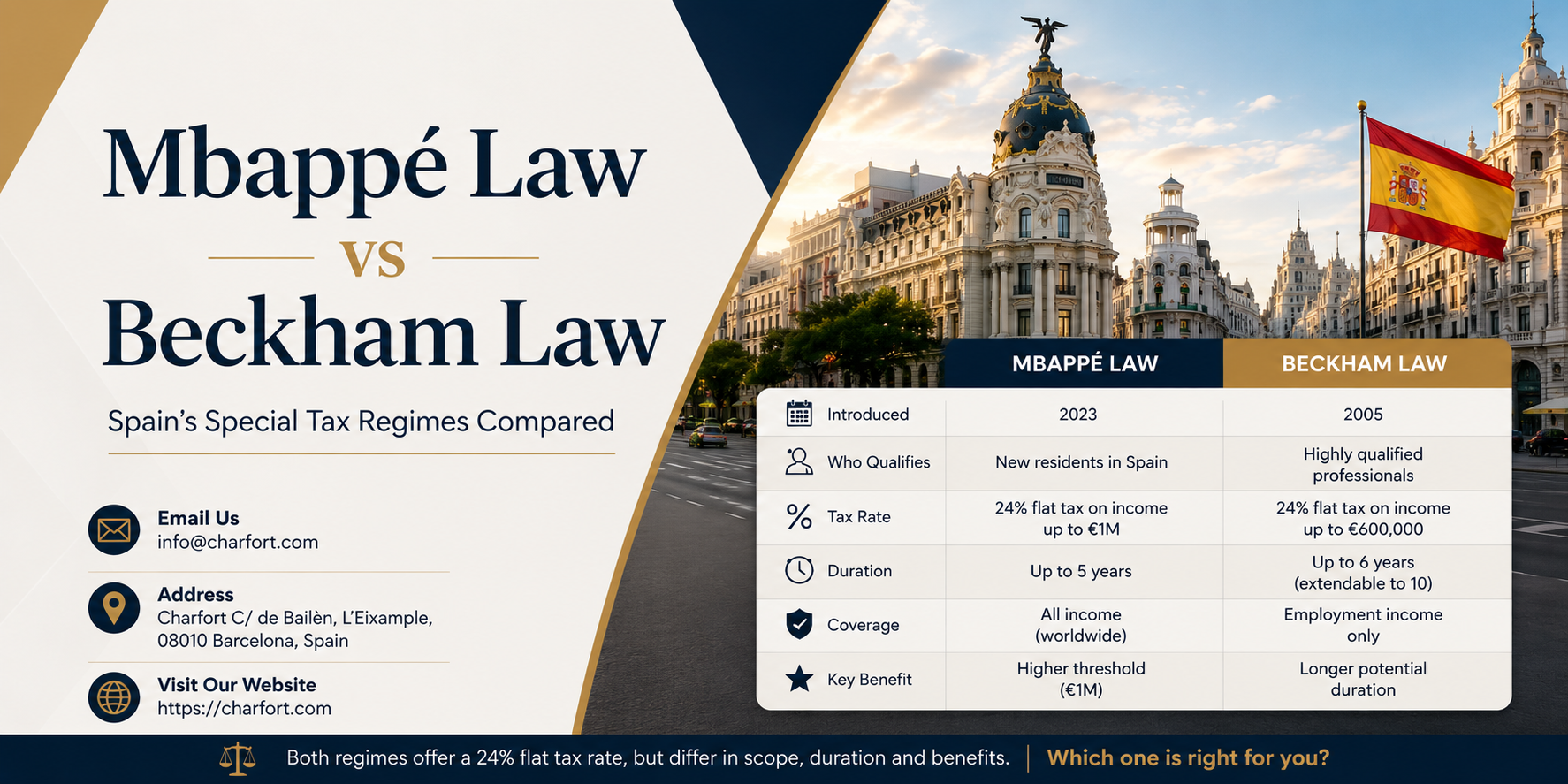
Did you know that Spain offers special tax breaks to attract high-net-worth individuals and skilled professionals? In 2026, these regimes continue to be a hot topic for those considering a move to Spain for work or investment. Two prominent options, often discussed interchangeably but with distinct differences, are the “Beckham Law” and the more recently introduced “Mbappé Law.” Understanding which one, if either, suits your unique financial situation is paramount. This in-depth guide will unravel the complexities of both, helping you discern their benefits, drawbacks, and suitability for your personal circumstances.
Who This Is For
This article is meticulously crafted for individuals who are:
- Considering relocating to Spain for employment, professional services, or investment purposes.
- High-net-worth individuals seeking to optimize their tax liabilities while residing in Spain.
- Professionals in specialized fields such as technology, finance, research, or sports, who may qualify for these preferential tax treatments.
- Entrepreneurs and business owners planning to establish or expand their operations in Spain.
- Anyone curious about Spain’s fiscal landscape and its appeal to international talent and investors.
- Individuals who have received a job offer or are contemplating self-employment in Spain.
Who This Is NOT For
This guide is not intended for:
- Individuals with no plans to relocate to Spain.
- Spanish residents who have lived in Spain for the past five years or more, as they generally do not qualify for these special regimes.
- Those seeking general Spanish tax advice unrelated to these specific expatriate tax regimes.
- Tourists or short-term visitors to Spain.
- Individuals who do not anticipate meeting the income or asset thresholds that might be relevant for certain interpretations or future iterations of these laws.
The Allure of Spain’s Special Tax Regimes
Spain, a country celebrated for its vibrant culture, beautiful landscapes, and burgeoning economy, has strategically employed fiscal policies to draw in foreign talent and investment. The core idea behind these special tax regimes is simple: make Spain a more attractive destination for individuals who can contribute significantly to its economic growth and innovation. By offering a more favorable tax structure compared to the standard Spanish income tax system, the government aims to incentivize relocation and sustained economic activity.
The standard Spanish income tax system, known as Impuesto sobre la Renta de las Personas Físicas (IRPF), can be quite progressive, with tax rates reaching up to 47% for the highest earners in 2026. For many high-earning professionals or investors, this can represent a substantial portion of their income. The special regimes, therefore, present a compelling alternative, allowing individuals to pay a flat rate on their Spanish-sourced income, significantly reducing their overall tax burden. This fiscal advantage can be a deciding factor when choosing between different countries for relocation, especially when considering long-term financial planning.
Furthermore, the appeal extends beyond just tax savings. Spain offers a high quality of life, excellent healthcare, a robust education system, and a rich cultural heritage. When combined with a more manageable tax framework, it becomes a truly compelling proposition for individuals and families looking to establish a new life. The regimes are designed to capture individuals who might otherwise be deterred by Spain’s standard tax rates, ensuring that the country benefits from their expertise and economic contributions.
Understanding the “Beckham Law” (Special Expatriate Tax Regime)
The “Beckham Law,” officially the Special Tax Regime for Inbound Workers, was introduced in 2004. Its name stems from the high-profile transfer of football superstar David Beckham to Real Madrid. This regime was designed to attract foreign professionals to Spain by allowing them to be taxed as non-residents, even after establishing residency.
Key Features of the Beckham Law
The primary advantage of the Beckham Law is its simplified and lower tax rate. For up to six years, eligible individuals pay a flat 24% tax on their employment income earned in Spain, up to a certain threshold. Income exceeding €600,000 is taxed at a higher rate, but the initial 24% is a significant draw. Crucially, under this regime, foreign-sourced income (such as dividends, interest, and capital gains from investments held outside Spain) is generally not taxed in Spain. This is a major distinction from the standard IRPF system, where worldwide income is typically subject to Spanish taxation.
Another key aspect is the tax treatment of capital gains. While employment income is taxed at a flat rate, capital gains derived from Spanish sources are taxed at standard rates. However, the exemption from taxing foreign income is the most powerful incentive. This allows expatriates to manage their global assets without incurring Spanish tax liabilities on income generated abroad, provided they meet the strict criteria.
Eligibility Criteria for the Beckham Law
To qualify for the Beckham Law, several conditions must be met:
- Non-Residency Prior to Move: The individual must not have been a tax resident in Spain for the five years preceding their move.
- Work Assignment in Spain: The move to Spain must be for the purpose of undertaking employment or performing professional services. This typically involves a formal employment contract or a significant client base if self-employed.
- Employer Not a Spanish Tax Resident: If employed, the employer should generally not be an entity that is tax resident in Spain. However, there are exceptions, particularly for individuals performing work for a Spanish company but whose employer is a foreign entity.
- Limited Business Activity Abroad: If the individual engages in business activities in Spain, the income derived from these activities must not exceed certain limits.
- Application Window: The application must be filed within six months of commencing work in Spain.
The regime offers a welcome reprieve from the complexities of international tax treaties and the standard progressive tax rates of the IRPF. It simplifies tax obligations and provides a predictable tax liability, which is invaluable for financial planning.
Introducing the “Mbappé Law” (Special Regime for Highly Skilled Professionals and Entrepreneurs)
The “Mbappé Law,” formally known as the “Special Tax Regime for the Attraction of Talent,” was introduced in 2023. While it shares the goal of attracting skilled individuals to Spain, it differs significantly in its scope, benefits, and eligibility. It’s often seen as an evolution or expansion of the principles behind the Beckham Law, but with a broader focus.
Key Features of the Mbappé Law
The Mbappé Law offers a flat 24% tax rate on employment and economic activity income for up to six years, similar to the Beckham Law. However, its most significant distinction lies in its broader application. It can cover individuals who move to Spain for work, including those who are self-employed (freelancers or entrepreneurs) and those who are not directly employed by a foreign entity but are performing services for Spanish companies.
Crucially, the Mbappé Law also extends its favorable tax treatment to other types of income, albeit with specific conditions and different rates. For instance, certain capital gains and investment income (like dividends and interest) earned outside Spain may also benefit from a more favorable tax treatment, or in some cases, be exempt, depending on specific circumstances and the interpretation of the law. This can be a substantial advantage for individuals with diverse income streams.
Furthermore, the Mbappé Law aims to encourage entrepreneurship. Individuals who establish a business in Spain may find this regime particularly beneficial, as it simplifies their tax obligations during the crucial initial years of operation. The flat tax rate provides a predictable cost of labor and personal income, aiding in business planning.
Eligibility Criteria for the Mbappé Law
The criteria for the Mbappé Law are also specific:
- Non-Residency Prior to Move: Similar to the Beckham Law, individuals must not have been tax residents in Spain for the five preceding years.
- Move for Work or Economic Activity: The relocation must be for employment or to carry out economic activities (self-employment, entrepreneurship).
- Work for Spanish Companies or Establish a Business: Unlike the Beckham Law, which often emphasizes a foreign employer, the Mbappé Law explicitly allows individuals working for Spanish companies (as employees or service providers) or establishing their own business in Spain to qualify.
- Income Threshold: There is a minimum income requirement, typically linked to the minimum interprofessional wage (SMI). As of 2026, this threshold is set at a level that ensures the regime benefits genuinely skilled professionals and entrepreneurs.
- Type of Activity: The regime is designed for highly skilled professionals, researchers, entrepreneurs, and digital nomads. Certain activities are specifically excluded, and the focus is on roles that contribute to innovation and economic development.
- Application Window: Like its predecessor, the application must be submitted within a specific timeframe, usually within six months of starting work or economic activity in Spain.
The Mbappé Law represents a more modern approach, acknowledging the changing nature of work and the rise of the gig economy and remote work. It seeks to capture a wider pool of talent, including those who might not fit the traditional employer-employee model.
Direct Comparison: Mbappé Law vs. Beckham Law
| Feature | Beckham Law (Special Expatriate Tax Regime) | Mbappé Law (Special Regime for Talent) |
|---|---|---|
| Primary Focus | Attracting inbound workers employed by foreign companies. | Attracting a broader range of talent, including self-employed and entrepreneurs. |
| Employment Structure | Primarily for individuals employed by a foreign entity. | Can apply to employment by Spanish entities, self-employment, and entrepreneurship. |
| Tax Rate (Employment) | Flat 24% on employment income up to €600,000. Higher rate above. | Flat 24% on employment and economic activity income up to €600,000. Higher rate above. |
| Foreign-Sourced Income | Generally exempt from Spanish taxation. | May be subject to favorable tax treatment or partial exemption, depending on type and circumstances. |
| Spanish-Sourced Capital Gains/Investment Income | Taxed at standard progressive rates. | May be subject to favorable tax treatment or partial exemption, depending on type and circumstances. |
| Eligibility Window | 5 years prior non-residency in Spain. | 5 years prior non-residency in Spain. |
| Application Deadline | Within 6 months of starting work. | Within 6 months of starting work/economic activity. |
| Flexibility | Less flexible, more focused on traditional employment. | More flexible, accommodating various work arrangements and entrepreneurial ventures. |
| Introduction Year | 2004 | 2023 |
| Target Audience | Executives, managers, highly skilled workers employed by foreign firms. | Highly skilled professionals, researchers, digital nomads, entrepreneurs, freelancers. |
Key Distinctions to Consider
The most significant difference lies in who you are working for and how you are working. If you are moving to Spain with a contract from a foreign company, the Beckham Law might be your primary route. However, if you are setting up your own business, freelancing for Spanish clients, or working remotely for a Spanish company, the Mbappé Law is likely the more appropriate and accessible option.
The treatment of foreign investment income is another crucial differentiator. While the Beckham Law offers a cleaner slate by generally exempting foreign income, the Mbappé Law’s approach is more nuanced. It aims to tax some foreign income at favorable rates, recognizing that many skilled individuals might have existing investments. The exact implications depend heavily on the specific types of income and their origin.
The Mbappé Law’s broader definition of “economic activity” is a game-changer for freelancers and entrepreneurs. It acknowledges the evolving work landscape and provides a structured way for these individuals to benefit from Spain’s attractive tax environment.
Navigating the Application Process
Applying for either regime requires careful attention to detail. The process typically involves:
- Obtaining a Spanish Tax Identification Number (NIF): This is a prerequisite for any tax-related activity in Spain. For foreigners, this often means obtaining a Spanish NIE Number (Número de Identificación de Extranjero).
- Gathering Documentation: This includes proof of non-residency, employment contracts or proof of economic activity, passport, and potentially other documents depending on the specific circumstances.
- Submitting the Application: The relevant tax form (e.g., Modelo 149 for the Beckham Law, or the equivalent for the Mbappé Law) must be submitted to the Spanish Tax Agency (Agencia Tributaria) within the stipulated six-month window.
- Tax Declarations: Once approved, you will need to file your annual tax returns according to the rules of the chosen regime.
It is highly advisable to engage a qualified tax advisor or a Real Estate Lawyer In Spain who specializes in expatriate taxation. They can guide you through the complex application process, ensure you meet all the eligibility requirements, and help you understand the ongoing tax obligations. Navigating Spanish bureaucracy can be challenging, and expert assistance can prevent costly errors.
Potential Pitfalls and What to Avoid
Mistakes in the application process or a misunderstanding of the rules can lead to the denial of your application or, worse, future tax liabilities. Here are common mistakes to avoid:
- Missing the Application Deadline: The six-month window is strict. Delays can mean losing eligibility.
- Misinterpreting Eligibility Criteria: Especially regarding the five-year non-residency rule or the nature of your work/employment.
- Incorrectly Declaring Income: Failing to distinguish between Spanish-sourced and foreign-sourced income, or misclassifying income types.
- Not Seeking Professional Advice: Attempting to navigate these complex tax laws without expert guidance is a significant risk.
- Underestimating Ongoing Obligations: Both regimes require specific tax filings. Simply applying and assuming everything is handled is a mistake.
- Changing Work Status Unintentionally: If your work situation changes significantly (e.g., becoming a permanent resident employed by a Spanish company under circumstances that disqualify you from the special regime), you must notify the authorities.
Understanding Understanding Spanish Property Laws – Home buyer Rights is also crucial if you plan to purchase property, as this is a separate legal consideration from tax residency.
The Beckham Law vs. Mbappé Law: Which is Better for You?
The question of “which is better” is entirely dependent on your individual circumstances.
- Choose the Beckham Law if: You are moving to Spain primarily for employment with a foreign-based company, and your main concern is minimizing tax on your Spanish employment income while keeping your foreign investment income entirely separate and untaxed in Spain. This regime offers a very clean break from Spanish taxation on foreign earnings.
- Choose the Mbappé Law if: You are self-employed, an entrepreneur starting a business in Spain, or employed by a Spanish entity. If you have diverse income streams, including foreign investments, and are comfortable with a slightly more complex but potentially broader tax optimization strategy, the Mbappé Law might be more suitable. Its flexibility for different work arrangements is its key strength.
It’s crucial to remember that both regimes are temporary, typically lasting for a maximum of six years. After this period, you will be subject to the standard Spanish IRPF tax rates. Therefore, long-term financial planning should account for this transition.
Calculating Potential Savings
To illustrate the impact, consider an individual earning €100,000 annually from employment.
- Under standard IRPF (2026 rates): This individual might pay roughly €28,000 – €35,000 in income tax, depending on deductions and regional variations.
- Under Beckham/Mbappé Law: The tax liability would be a flat 24% of €100,000, totaling €24,000.
This represents a potential saving of €4,000 – €11,000 annually. For higher earners, the savings are exponentially greater. For example, on €600,000, the standard IRPF could be well over €250,000, whereas the special regimes cap the tax at €144,000 (24% of €600,000), a saving of over €100,000.
For those interested in property investment, understanding how to Calculate ROI On Spanish Rental Property is essential, regardless of which tax regime they fall under, as rental income will be taxed differently depending on their status.
The Future of Spain’s Tax Regimes
The introduction of the Mbappé Law signals a clear intention by the Spanish government to adapt its tax policies to the modern economy. As remote work and globalized professional services become more prevalent, these regimes are likely to evolve further. The focus remains on attracting talent and capital, fostering economic growth, and making Spain a competitive international destination.
It’s important to stay informed about any legislative changes. Tax laws can be dynamic, and what applies today might be subject to revision in the coming years. Staying connected with tax professionals and official government resources is key to remaining compliant and maximizing benefits. The Requirements For Spanish Citizenship are a separate, long-term consideration for those planning to make Spain their permanent home.
Conclusion
Spain’s special tax regimes, embodied by the Beckham Law and the Mbappé Law, offer significant financial advantages for eligible expatriates. While both provide a reduced tax rate on employment income, they cater to different profiles and work situations. The Beckham Law remains a strong option for those employed by foreign entities, offering a clean exemption on foreign income. The Mbappé Law, however, presents a more modern and flexible framework, extending benefits to entrepreneurs, freelancers, and those working with Spanish companies, while also offering nuanced treatment for other income types.
Choosing between them requires a thorough assessment of your employment status, income sources, and long-term goals. Consulting with a specialist tax advisor is not merely recommended; it is essential for navigating the complexities and ensuring you select the regime that best aligns with your financial objectives and legal obligations. By understanding these distinctions, you can make an informed decision that supports your relocation and financial well-being in Spain.
Key Takeaways
- Spain offers special tax regimes (Beckham Law and Mbappé Law) to attract foreign talent.
- Both regimes offer a flat 24% tax rate on employment income up to €600,000 for up to six years.
- The Beckham Law is primarily for individuals employed by foreign companies, with general exemption for foreign-sourced income.
- The Mbappé Law is broader, covering self-employed individuals, entrepreneurs, and those working with Spanish companies, with more nuanced treatment of other income types.
- Eligibility requires not being a Spanish tax resident for the past five years and moving for work or economic activity.
- Strict application deadlines (usually six months from starting work) apply.
- Professional tax advice is crucial for navigating eligibility and application processes.
- Both regimes are temporary, and standard Spanish tax rates apply after six years.
Frequently Asked Questions
Can I apply for the Beckham Law if I’m self-employed?
Generally, the Beckham Law was primarily designed for individuals employed by a foreign entity. If you are self-employed or an entrepreneur moving to Spain, the newer Mbappé Law (Special Regime for Talent) is likely the more appropriate and accessible option, as it explicitly covers economic activities and business creation. It’s crucial to verify your specific situation with a tax professional.
What happens if my circumstances change while I’m under one of these regimes?
If your work situation changes significantly – for instance, if you become a permanent Spanish resident employed by a Spanish company in a way that disqualifies you from the special regime, or if you cease economic activity – you must inform the Spanish Tax Agency. Failure to do so could lead to the revocation of the special tax status and potential back taxes.
How long do these tax regimes last?
Both the Beckham Law and the Mbappé Law typically grant preferential tax treatment for a maximum of six years. After this period, individuals will be subject to the standard Spanish income tax (IRPF) rates, which are progressive and can be significantly higher. It is important to plan for this transition.
Is it mandatory to hire a lawyer to apply for these regimes?
While not strictly mandatory in all cases, it is highly recommended to engage a qualified tax advisor or a lawyer specializing in Spanish expatriate tax law. The application process involves specific forms, documentation, and deadlines. Expert guidance ensures accuracy, compliance, and maximizes your chances of approval, preventing costly errors or missed opportunities.
Does the Mbappé Law tax foreign investment income?
The Mbappé Law offers a more complex approach to foreign-sourced income compared to the Beckham Law. While it aims to provide favorable tax treatment or partial exemptions for certain types of foreign investment income (like dividends and capital gains), it does not offer a blanket exemption. The specific tax treatment depends on the type of income, its origin, and prevailing tax treaties. Detailed consultation with a tax expert is essential to understand the precise implications for your investment portfolio.