
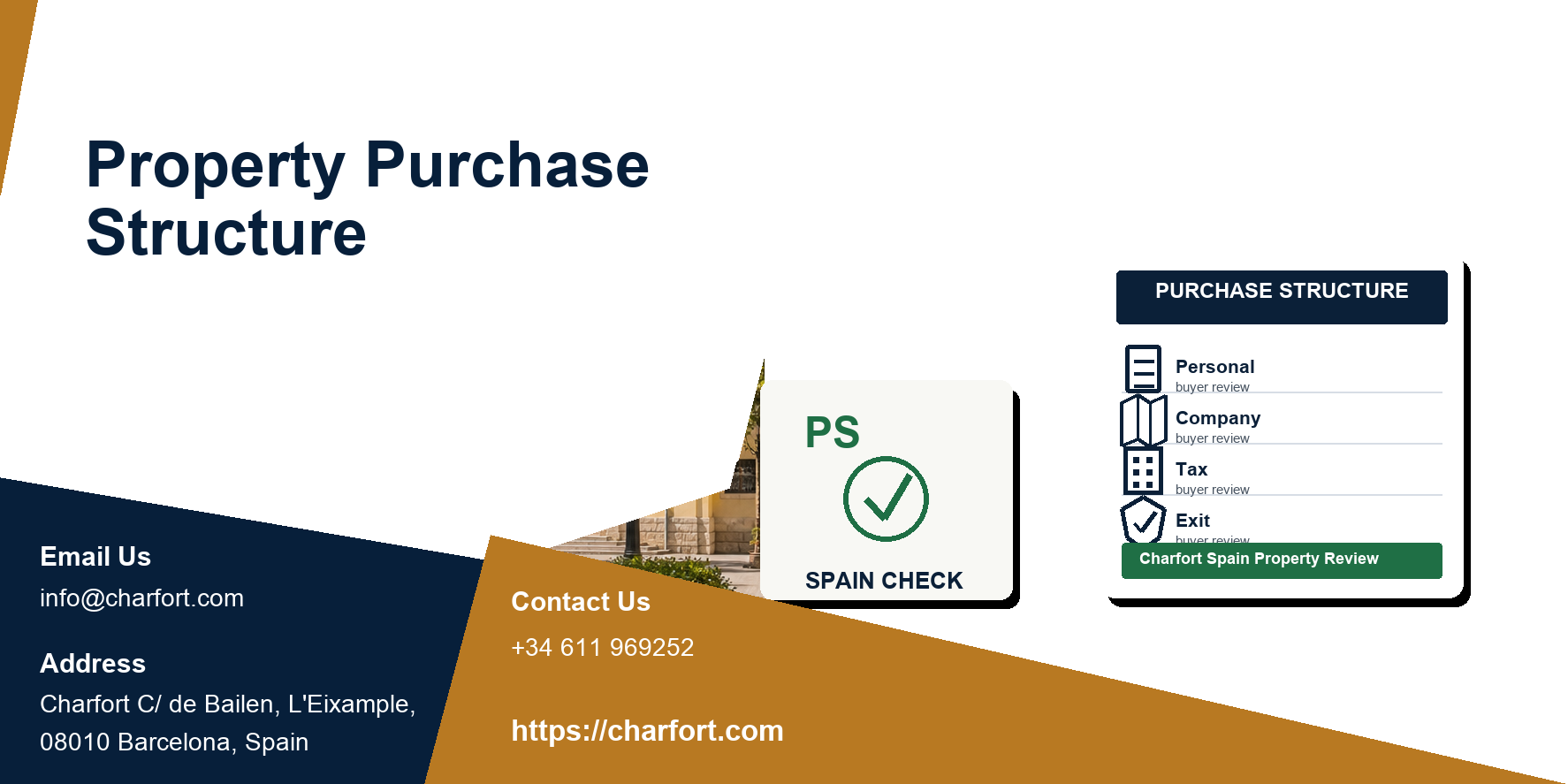
Many foreign buyers decide the structure too late. They find a property, agree a price, and only then ask whether to buy personally, through a company, with family members, or under another ownership arrangement. That order can create tax, financing, banking, inheritance, and AML friction. This article provides general information for Spanish property buyers and does not replace advice based on personal, legal, tax, or financial circumstances.
Structuring a Spanish property purchase means deciding who buys, how funds move, how the asset will be used, how taxes and liability may apply, and what happens on rental, sale, inheritance, or relocation. The right structure depends on personal facts, tax residence, financing, family planning, and investment purpose.
Key Checks
| Decision | Why it matters | Review with |
|---|---|---|
| Personal vs company ownership | Affects tax treatment, financing, accounting, administration, rental treatment, liability, and exit. | Tax adviser and lawyer. |
| Resident vs non-resident position | Changes reporting, tax exposure, and compliance questions. | Spanish tax adviser. |
| Use of property | Main home, second home, rental, development, or corporate use can point to different risks. | Tax adviser, lawyer, and financing adviser. |
| Family and inheritance | Co-ownership and succession planning can affect future control and cost. | Lawyer and estate-planning adviser. |
| Funding route | Source-of-funds and AML evidence must match the buyer and structure. | Lawyer, bank, and AML reviewer. |
What This Pillar Owns
This page maps the structuring decision. The deeper comparison of individual and company acquisition belongs to buying Spanish property personally vs through a company. Transaction security belongs to buyer protection in Spain. Property verification belongs to property due diligence in Spain.
When to Decide Structure
The structure should be reviewed before offer or at least before the private contract. Changing buyer identity late can affect financing, AML evidence, tax analysis, contract wording, and the seller’s willingness to continue.
Questions to Answer First
- Who will legally own the property?
- Will the buyer be Spanish tax resident, non-resident, or moving between jurisdictions?
- Will the property be used personally, rented, developed, or held as an investment?
- Will financing be personal, company-funded, or mixed?
- What happens if the owner dies, sells, relocates, or changes tax residence?
- What annual compliance, accounting, or reporting burden is acceptable?
Common Structuring Mistakes
- Assuming a company is automatically tax-efficient.
- Buying personally and later discovering succession or family-control problems.
- Using company funds for a personal purchase without tax and AML review.
- Ignoring non-resident tax, wealth tax, inheritance, or rental-income compliance.
- Changing buyer identity after contract documents have already been prepared.
What to Confirm Before the Buyer Becomes Committed
For Spanish property purchase structuring, the practical goal is not to collect documents for their own sake. The goal is to understand whether the buyer can still make a clear decision before the next payment, signature or completion step. A weak file usually creates pressure later, when the seller expects progress and the buyer has less room to negotiate.
The evidence file should cover buyer identity, tax residence, intended use, financing source, rental plan, family ownership, inheritance concerns, corporate records, beneficial ownership, expected exit and annual compliance capacity. Those items do not all carry the same weight in every transaction. A city apartment, a rural house, a coastal villa, a new-build unit, a tenanted investment and a company-owned acquisition each raise different questions. The buyer should therefore ask which facts would change the decision, which facts would change the price and which facts would require a contract condition before funds move further.
If the seller or agent says a point is standard, the buyer should still ask what document proves it. If the answer is only verbal, the issue is not necessarily fatal, but it is unresolved. In a Spanish purchase, unresolved does not mean harmless. It means the buyer should decide whether to verify, renegotiate, make the contract conditional or stop.
Buyer Scenario
Assume a buyer wants to acquire a Spanish property for mixed personal and investment use. Funds may come from outside Spain, family members may contribute and the buyer is considering whether the property should be owned personally or through a company. In that situation, the buyer should avoid treating the problem as a minor administrative delay. The missing evidence may affect legal use, possession, financing, tax treatment, renovation timing, resale, completion mechanics or the buyer’s ability to walk away without losing leverage.
The safest response is to convert the uncertainty into a written checklist. The buyer should identify what is known, what is missing, who can verify it and by when. The answer may be simple, but it should still be evidenced before the buyer signs a private contract or transfers a larger deposit. If the issue cannot be resolved before the next deadline, the contract should say what happens if the answer later proves unacceptable.
This is also where buyer-side coordination matters. A lawyer may see the legal issue, a surveyor may see the physical issue, a bank may see the financing issue and a tax adviser may see the ownership or reporting issue. The buyer needs those views brought together into a commercial decision, not left as separate professional comments.
Questions to Ask Before Contract
Use these questions before reservation, private contract or completion:
- Who should legally own the property and why?
- How will the property be used immediately and in five years?
- What tax residence and reporting position applies to each owner?
- Will financing, AML evidence and contract timing support the chosen structure?
- What happens on rental, sale, inheritance, divorce, relocation or company restructuring?
The answer to each question should be specific enough to change action. A useful answer says what evidence exists, whether the evidence is current, who checked it and what risk remains. A weak answer says the issue is probably fine, common in Spain or expected to be solved later. Those phrases may be true in some cases, but they are not a substitute for review.
The intended funding route should be tested before the acquisition structure is finalised. A lender may assess personal and company borrowers differently, while an unfinanced acquisition places more emphasis on liquidity and the source-of-funds trail. Compare the foreign-buyer mortgage process with the controls in Buying Property in Spain with Cash before implementing the structure.
How This Fits the Wider Purchase File
Purchase structuring connects personal ownership, company ownership, individual taxation, company taxation, proof-of-funds checks and buyer protection. The buyer should not treat these checks as separate silos. A single unresolved fact can affect several parts of the purchase. For example, a document gap may change the legal risk, the lender’s position, the negotiation strategy and the wording needed in the private contract.
The file should also match the buyer’s real objective. Someone buying a second home for family use has different risk tolerance from an investor relying on rental income. A buyer using mortgage finance has different timing pressure from a cash buyer. A buyer purchasing through a company may need a different AML and tax file from an individual buyer. The same property can therefore be acceptable for one buyer and unsuitable for another.
Practical Decision Framework
A buyer can normally sort the outcome into four categories. First, the evidence is satisfactory and the transaction can move forward. Second, the evidence is incomplete but fixable before contract. Third, the evidence is incomplete and should be covered by a contract condition, retention, price adjustment or seller obligation. Fourth, the evidence reveals a risk that does not match the buyer’s intended use or risk tolerance.
The important point is to choose the category deliberately. the buyer should decide structure before the private contract, because changing the buyer late can affect tax analysis, AML evidence, financing and completion. That decision should be made before emotion, timing pressure or sunk costs make the purchase harder to control.
Charfort’s role is to help international buyers keep the transaction file connected. The work does not replace the specialist role of a Spanish tax adviser, Spanish property lawyer, bank or mortgage adviser and buyer-side coordinator, but it helps the buyer ask the right questions, keep deadlines visible and understand how each answer affects the decision to reserve, renegotiate, continue or stop.
How Charfort Helps
Charfort can coordinate purchase-structure review with Spain individual taxation support, Spain company taxation support, and Spain property buying support so the tax, legal, funding, and transaction plan agree before completion.
FAQs
What does structuring a property purchase mean?
It means choosing the buyer, ownership form, funding route, tax position, family-control approach, and compliance plan before the property is acquired.
Should I decide structure before making an offer?
Ideally yes. Structure affects contract wording, AML evidence, financing, tax advice, and completion steps.
Is a company always better for buying Spanish property?
No. A company may help in some cases and create extra tax, accounting, financing, and compliance burden in others.
Can Charfort give tax advice?
Charfort can coordinate tax advisory support and planning, but advice should be based on the buyer’s personal facts and reviewed by a qualified tax adviser.
Does tax residence matter?
Yes. Tax residence can affect income tax, wealth tax, reporting, and wider planning questions.
What is the next page to read?
The next specialist page is buying personally vs through a company.
Conclusion
Structuring a Property Purchase in Spain is not a standalone paperwork exercise. It is a buyer decision point inside a larger Spanish property transaction. The safer path is to define the risk, request evidence early, use the right professionals, and align the contract with what the documents actually show. Charfort can help international buyers keep that process disciplined before the next payment, signature, or completion date.