
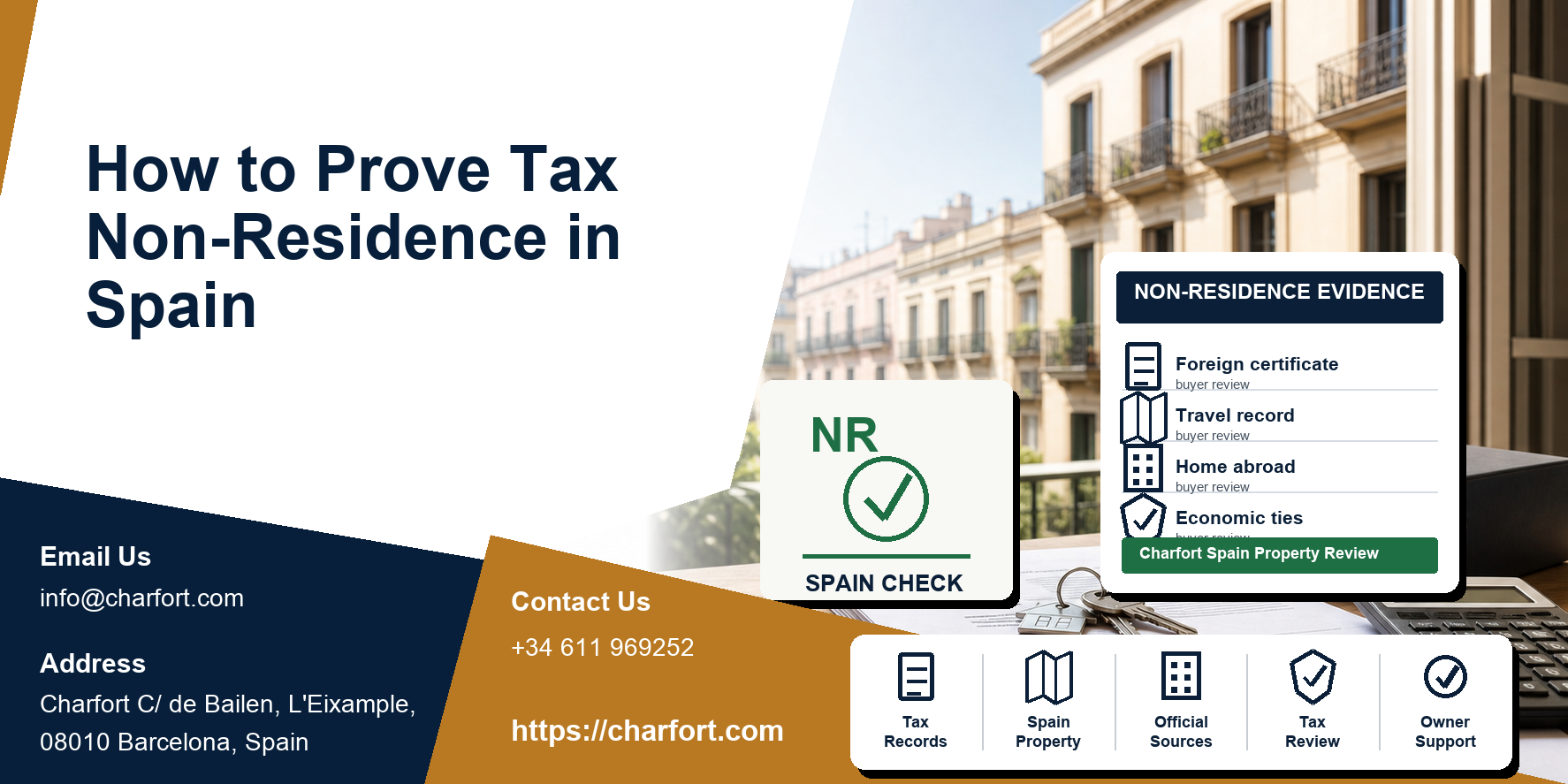
How to Prove Tax Non-Residence in Spain is relevant whenever a Spanish property decision crosses a tax boundary: moving to Spain, keeping a holiday home, receiving rent, selling, inheriting, or managing an overseas asset. The answer depends on the taxpayer, the property, the income or event, the relevant tax year and, in some cases, the autonomous community or tax treaty. This guide explains the decision in a practical order so that an owner can prepare the right records before a filing, contract or payment deadline.
This article provides general information and does not replace advice based on your personal, legal, tax or financial circumstances. Spanish tax treatment can change with residence, property use, ownership structure, autonomous-community rules, treaty position and the facts of the transaction.
In short: Proving tax non-residence in Spain is an evidence exercise, not a declaration of preference. A foreign tax-residence certificate can be important, but it should be consistent with travel days, habitual home, work and business facts, and the location of personal and economic ties. The evidence must relate to the relevant Spanish calendar year.
What this means for a Spanish property owner
Proving tax non-residence in Spain is an evidence exercise, not a declaration of preference. A foreign tax-residence certificate can be important, but it should be consistent with travel days, habitual home, work and business facts, and the location of personal and economic ties. The evidence must relate to the relevant Spanish calendar year. The practical point is to establish the facts before choosing a form, calculation or adviser instruction. A tax result can turn on a small distinction: a day spent in Spain, a change from private use to rental use, a co-owner’s different residence status, an invoice that proves an improvement rather than a repair, or an autonomous-community rule that applies to the property.
For an international owner, this is rarely only an accounting task. The property file should connect the title, ownership percentage, property use, payment records, relevant dates and country of residence. Keeping those items together makes it easier to obtain tailored advice and reduces the chance that a later filing must be reconstructed from emails, booking-platform screenshots and unexplained bank transfers.
The four questions to answer before you act
| Question | What to check | Why it matters |
|---|---|---|
| Who is the taxpayer? | Owners who live abroad, frequent travellers, people leaving Spain, remote workers and families with homes or businesses in more than one country. | Residence, ownership percentages and legal capacity can change the filing route. |
| What happened this year? | Match the property use, income, ownership or transaction event to dated records. | Tax treatment follows the real facts, not a shorthand description. |
| What must be retained? | a current foreign tax-residence certificate where available, entry and exit history, home and utility evidence abroad, employment or business documents, school and family records, and Spanish property-use records. | A return or position is stronger when the documents tell the same story. |
| What needs a current check? | Forms, deadlines, regional rules and treaty terms for the relevant tax year. | Tax guidance and filing mechanics can change after an article is published. |
The table is designed as a decision tool, not a substitute for professional advice. Its value is in exposing missing facts early. If the property file cannot show who owned the asset, how it was used and when a payment or change occurred, pause the calculation until the evidence is complete.
Who should review this issue
Owners who live abroad, frequent travellers, people leaving Spain, remote workers and families with homes or businesses in more than one country. A property manager, estate agent, notary, accountant and lawyer may each hold part of the information, but none should be assumed to hold the full tax picture. The owner should identify one responsible professional who can coordinate the tax analysis with the transaction record.
This is particularly important where an owner is changing country of residence, has a spouse or co-owner in another jurisdiction, uses a property partly personally and partly for rent, or owns through a company or other vehicle. In those cases, a tax adviser needs more than the most recent bill: they need a dated chronology and documents that match it.
Evidence to prepare
Before relying on a tax position, collect a current foreign tax-residence certificate where available, entry and exit history, home and utility evidence abroad, employment or business documents, school and family records, and Spanish property-use records. Keep documents in a file that can be understood by someone who was not involved in the original purchase or rental. Name documents by date, property and purpose; retain both the invoice and proof of payment where a cost or filing depends on it.
Do not wait until a sale, tax return or family event to rebuild the evidence. A purchase file that is organised from completion, a rental ledger updated monthly and a travel record reconciled during the year are easier to review and less likely to omit a relevant fact.
A practical review sequence
Use the following sequence before you file, sign or pay:
- Identify the exact tax year and the Spanish residence test that could be in issue.
- Request a foreign certificate where the other country issues one, and check its dates and wording.
- Reconcile travel evidence with housing, work, banking and family evidence rather than keeping isolated documents.
- Escalate dual-residence cases for treaty review before making a filing or formal representation.
The order matters. Starting with a calculation before confirming residency, ownership or property use can produce a neat-looking answer to the wrong question. A short written chronology often reveals where specialist advice is needed: for example, a change of residence, an unexplained period of private use, a family transfer, or a payment made by a person who is not the legal owner.
The decisions that can change the result
The legal label on a property is not always enough. A home may be personally available for part of a year and rented for another part. An owner may be non-resident at the beginning of the year and resident later. A family may hold bare ownership and usufruct separately. A sale may involve resident and non-resident co-owners. These facts should be recorded before a return is prepared.
A certificate from another country does not erase contradictory Spanish facts. Missing travel evidence or an unexplained Spanish home can weaken a file even where the person genuinely lives elsewhere. The sensible response is not to overstate certainty. Ask a Spanish tax adviser to verify the current rules for the exact period and, where appropriate, coordinate the review with the property lawyer, notary, municipal authority or foreign adviser.
A property-owner scenario
An owner based in France lets a Spanish flat for part of the year and visits for viewings and repairs. The owner should retain the French certificate and a reconciled travel and property-management file, not merely rely on a foreign mailing address.
The scenario is illustrative only. It does not establish a tax outcome for another owner. The key lesson is to identify the relevant date, taxpayer, property use and supporting document before treating any payment, cost or return as routine.
Common errors to avoid
- Treating a tax residence visa, property address or foreign mailing address as conclusive evidence without checking the legal tests.
- Applying a national rule as though every autonomous community or municipality uses the same timetable, relief or procedure.
- Mixing private, rental and business records so that actual property use cannot be demonstrated.
- Assuming that an online filing form or a previous year’s return proves the current year’s treatment.
- Relying on a broad online summary instead of the current official form instructions and the taxpayer’s specific treaty or regional position.
Related Charfort guidance
This topic sits alongside Tax Residency in Spain: 183 Days, Economic Interests and Treaty Tests, Spanish Tax Resident vs Non-Resident: Property and Income Obligations. Where cross-border residence or reporting is involved, also review Double-Taxation Treaties and Foreign Tax Credits for Spanish Property Income. For a wider non-resident overview, see Charfort’s guide to non-resident tax in Spain; owners receiving rent should also review non-resident landlord tax obligations.
For property transactions, tax records should be considered with the legal and documentary file. Charfort’s Spain property due-diligence guidance and buyer-side property service can help international clients coordinate the tax questions with ownership, contract and completion evidence.
How Charfort can help
Charfort helps international clients identify the facts and documents that a Spanish tax adviser needs before a property decision becomes difficult to unwind. Through Spain individual tax advisory, Charfort can coordinate residency, ownership, rental, sale and reporting questions with qualified Spanish tax professionals. The role is to make the property file and commercial decision clearer; it does not replace personalised tax, legal or financial advice.
Sources and review note
The sources below are official Spanish materials available on the review date. Tax rates, forms, filing periods, regional rules and treaty application should be checked again for the taxpayer’s actual year and facts.
FAQs
1. Does owning property in Spain automatically create this tax result?
No. Property ownership is an important fact, but the result also depends on residence, use, ownership percentage, income or transaction type, timing and current rules.
2. Do co-owners always have the same filing position?
No. Co-owners can have different residence status, ownership percentages, income shares and evidence. Each person’s position should be reviewed separately.
3. Can a foreign tax-residence certificate settle every Spanish question?
Not by itself. It may be important evidence, but it needs to fit the travel, home, economic-interest and treaty facts for the relevant year.
4. Which records should I keep?
Keep the title, invoices, proof of payment, contracts, property-use calendar, tax filings, municipal notices and relevant residence evidence. The precise list depends on the issue explained in this guide.
5. Are the rules the same throughout Spain?
No. National tax rules can interact with autonomous-community and municipal rules. Confirm the property’s location and the current tax year before relying on a general summary.
6. How can Charfort help?
Charfort can organise the property and residency facts, identify the right questions for a qualified Spanish tax adviser and coordinate the wider purchase, ownership, rental or sale file.
Conclusion
How to Prove Tax Non-Residence in Spain should be approached as a documented property-tax decision, not as a formality. Begin with the taxpayer, the property event and the evidence; then verify the current rules that apply to those facts. That sequence gives an owner a more reliable basis for filing, planning and professional advice.