
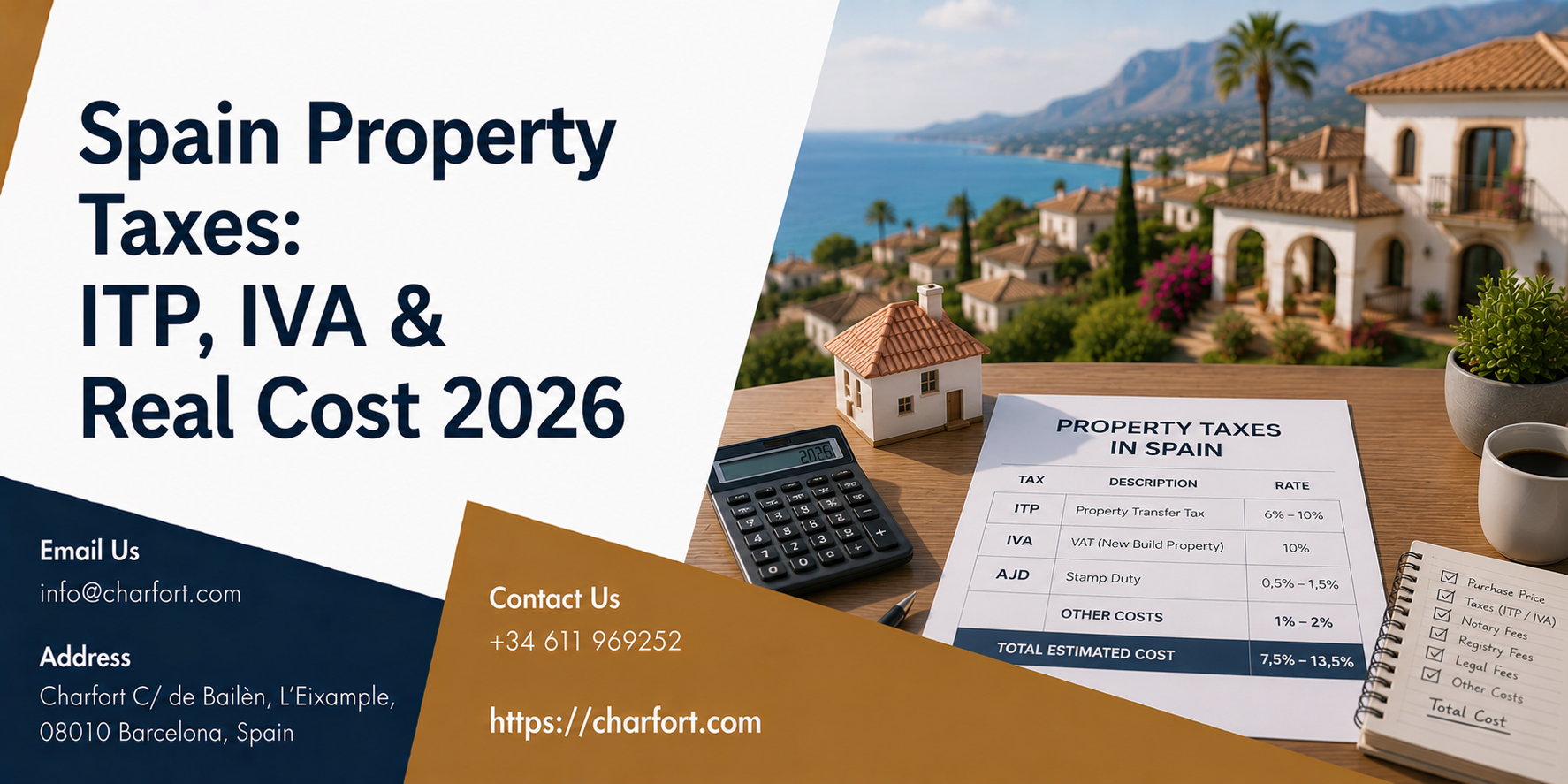
Buying property in Spain offers a compelling prospect for many, whether for a holiday home, investment, or relocation. However, understanding the associated tax implications is crucial to accurately calculate the real cost of your purchase. Two significant taxes you will encounter are the Impuesto de Transmisiones Patrimoniales (ITP) and Impuesto sobre el Valor Añadido (IVA). These taxes, alongside other associated fees, can add a substantial percentage to the advertised property price. As of 2026, navigating these fiscal landscapes requires a clear understanding of their application, rates, and regional variations. This article breaks down ITP and IVA, helping you budget effectively for your Spanish property acquisition.
Understanding the Landscape of Property Taxes in Spain
Spain’s property market is subject to various taxes, both at the national and regional levels. For a buyer, the most significant tax considerations upon purchasing a property are ITP and IVA. These are not mutually exclusive; which one applies depends primarily on whether the property is newly built or resale. Additionally, other costs like notary fees, land registry fees, and potential mortgage costs contribute to the overall expense. By understanding these components, buyers can avoid unexpected financial burdens and proceed with confidence.
What is the Impuesto de Transmisiones Patrimoniales (ITP)?
The Impuesto de Transmisiones Patrimoniales (ITP) is a regional tax levied on the transfer of existing or resale property. This tax applies when you buy a property that has been previously owned and is not being sold by the original developer. The ITP is managed and collected by the autonomous communities (regions) of Spain, meaning the rates and specific rules can vary significantly from one region to another.
ITP is calculated based on the declared value of the property in the deed, which is typically the higher of the sale price or the cadastral value (valor catastral). The rates are applied as a percentage. For instance, if the declared value is €200,000 and the regional ITP rate is 7%, the tax payable would be €14,000. This tax is generally paid by the buyer before the property title is officially registered.
What is the Impuesto sobre el Valor Añadido (IVA)?
The Impuesto sobre el Valor Añadido (IVA), commonly known as Value Added Tax (VAT) in English, is a national tax that applies to new properties. This includes properties purchased directly from a developer or builder for the first time. Unlike ITP, IVA is a national tax, but its rate for new properties is set by the central government, though some regions may have slight variations or exemptions.
For residential properties, the standard IVA rate in Spain is 10%. This 10% is applied to the purchase price of the new build property. For example, if a new apartment costs €300,000, the IVA payable would be €30,000. In addition to IVA, when purchasing a new build property, buyers also typically pay Impuesto sobre Actos Jurídicos Documentados (AJD), a tax on documented legal acts, which is also a regional tax and varies in percentage.
Key Differences Between ITP and IVA in Property Purchases
The fundamental distinction between ITP and IVA when buying property in Spain lies in the type of property being transacted. Understanding this difference is the first step in correctly estimating your tax liabilities.
- ITP applies to: Resale properties – those that have had previous owners.
- IVA applies to: New build properties – those sold for the first time by the developer or builder.
Furthermore, the rates differ. While ITP rates are set regionally and can vary widely, the standard IVA rate for new residential properties is a consistent 10% nationwide. However, the AJD, which often accompanies IVA on new builds, is regional. This means a new build purchase might involve both IVA and AJD, whereas a resale purchase involves only ITP.
Calculating the Real Cost: Beyond the Property Price Tag
The advertised price of a Spanish property rarely reflects the total amount you will pay. Both ITP and IVA, along with other transactional costs, add to the final outlay. Buyers should budget an additional 10% to 15% on top of the property’s sale price to cover these taxes and fees. This buffer ensures you are financially prepared for the entire process.
For resale properties, the primary tax is ITP, typically ranging from 6% to 11% depending on the region. For new builds, it’s IVA (10%) plus AJD, which can add another 0.5% to 1.5% depending on the region. Beyond these main taxes, consider:
- Notary fees: For the escritura pública (public deed).
- Land Registry fees: To register your ownership.
- Legal fees: For your lawyer’s services.
- Mortgage costs: If applicable (arrangement fees, valuation).
- Bank transfer fees: For international payments.
By factoring in these elements, you gain a much clearer picture of the total investment.
A Deep Dive into ITP: Taxes on Resale Properties
The Impuesto de Transmisiones Patrimoniales (ITP) is the tax you will pay when purchasing a property that is not brand new. This means any property that has had a previous owner falls under ITP. As a regional tax, its rates are not uniform across Spain, creating a dynamic fiscal environment that buyers must research based on their target location.
ITP Rates Across Spain’s Autonomous Communities
The ITP rate is determined by the autonomous community where the property is located. While the Spanish government sets a framework, each region has the authority to set its own percentages within a defined range. Generally, these rates fall between 6% and 11% of the property’s declared value.
Here’s a look at how ITP rates can vary:
- Andalusia: Typically around 7% (though subject to change).
- Catalonia: Often around 10%.
- Valencian Community: Usually around 10%.
- Madrid: Around 6%.
- Balearic Islands: Can be higher, sometimes up to 8-11% depending on the property value and specific island.
- Canary Islands: Has its own tax called IGIC, but for property transfers, it often uses a similar structure to ITP, with rates around 6.5%.
It is crucial to verify the exact ITP rate for the specific region and municipality where you intend to buy, as these can be updated annually or even more frequently.
What is the Taxable Base for ITP?
The taxable base for ITP is the value declared in the public deed (escritura pública) of sale. This value is generally the higher of:
- The actual sale price agreed upon by buyer and seller.
- The official valuation assigned by the regional tax authorities (known as valor de referencia or valor comprobado).
Tax authorities in Spain are vigilant about under-declarations. If they deem the declared value to be significantly lower than the market value or the official valuation, they can investigate and impose penalties, including back taxes, interest, and fines. Therefore, it is always advisable to declare the correct, higher value to avoid future complications.
Special ITP Rates and Exemptions
Some autonomous communities offer reduced ITP rates for specific buyer profiles or property types. These can include:
- Young Buyers: Lower rates for individuals under a certain age (e.g., 35).
- First-Time Buyers: Reduced rates for those purchasing their primary residence.
- Large Families: Special concessions for officially registered large families.
- Social Housing: Discounted rates for properties designated as social housing.
These reductions are not universal and vary significantly by region. Buyers should inquire about any available benefits in their chosen location.
Understanding IVA: Taxes on New Build Properties
The Impuesto sobre el Valor Añadido (IVA), or VAT, is the tax applied when purchasing a property directly from a developer or builder for the first time. This signifies that the property has never been occupied or sold before. For new builds, IVA is the primary tax, but it is often accompanied by the Impuesto sobre Actos Jurídicos Documentados (AJD).
The Standard IVA Rate for New Properties
The standard IVA rate for the sale of new residential properties in Spain is 10%. This rate applies to the purchase price of the property. For example, if you buy a new apartment for €300,000, the IVA you would pay is €30,000 (€300,000 x 10%). This amount is paid directly to the developer at the time of purchase, usually alongside the deposit and final payment.
It is important to note that this 10% rate is for residential properties. Commercial properties or garages sold separately might be subject to a higher IVA rate (currently 21%).
What is the Impuesto sobre Actos Jurídicos Documentados (AJD)?
When you purchase a new build property, you will typically pay both IVA and AJD. The AJD is a tax levied on specific legal documents, including property deeds that are registered. The rate for AJD varies by autonomous community, generally ranging from 0.5% to 1.5% of the property’s value.
The taxable base for AJD is usually the declared value in the public deed. The application of AJD on new builds has been a subject of legal debate, particularly concerning who is responsible for paying it. However, current legislation generally places the burden of AJD on the buyer for new property purchases.
Example Calculation for a New Build Property:
Let’s assume a new property is purchased for €300,000 in a region where AJD is 1%.
- Purchase Price: €300,000
- IVA (10%): €30,000 (€300,000 x 0.10)
- AJD (1%): €3,000 (€300,000 x 0.01)
- Total Taxes (IVA + AJD): €33,000
- Total Cost (Price + Taxes): €333,000
This illustrates how new builds can incur significant tax costs beyond the sticker price.
Who Collects IVA and AJD?
IVA is a national tax collected by the Spanish Tax Agency (Agencia Tributaria). Developers are responsible for charging and remitting this tax to the state. AJD, however, is collected by the autonomous communities, making its rate variable depending on the region.
Other Costs Associated with Buying Property in Spain
Beyond the primary taxes of ITP and IVA, numerous other expenses contribute to the overall cost of acquiring Spanish property. These fees are essential to factor into your budget for a realistic financial plan.
Notary Fees
A notary (notario) is a public official who authenticates legal documents, including the property purchase deed (escritura pública de compraventa). Their role is to ensure the transaction is legal and to protect the interests of all parties involved. Notary fees are regulated by law, but the final amount can vary based on the property’s value and the complexity of the transaction. Typically, these fees can range from €600 to €1,500.
Land Registry Fees
Once the purchase deed is signed before the notary, it must be registered with the local Land Registry (Registro de la Propiedad). This registration formally transfers ownership and makes your claim public record. Land Registry fees are also regulated and depend on the property’s declared value. Expect to pay between €400 and €1,200 for this service.
Legal Fees and Representation
It is highly recommended to hire an independent lawyer (abogado) specializing in Spanish property law. Your lawyer will conduct due diligence, review all contracts, ensure legal compliance, and represent your interests throughout the buying process. Legal fees typically range from 1% to 1.5% of the property’s purchase price, plus VAT. This service is invaluable, especially for foreign buyers unfamiliar with Spanish legal intricacies. Understanding What Services Do Buyer’s Agents Offer in Spain? can also shed light on crucial support systems.
Mortgage Costs
If you are financing your purchase with a mortgage, additional costs will apply. These include:
- Mortgage Arrangement Fee: A percentage of the loan amount charged by the lender.
- Valuation Fee: The bank will commission a valuation of the property.
- Notary and Registry Fees for the Mortgage Deed: Separate from the property purchase deed.
- Bank’s Legal Fees: For the mortgage contract.
The Spanish mortgage market has specific regulations regarding these costs, with some now legally mandated to be borne by the lender. However, it’s wise to confirm all associated charges with your chosen bank.
Other Potential Costs
- Bank Transfer Fees: For moving funds internationally.
- Currency Exchange Costs: If purchasing from abroad, the exchange rate can significantly impact the final cost.
- Community Fees: For properties in developments with shared facilities (pools, gardens, security), you will pay monthly or annual community fees.
Property Taxes (Annual): Once you own the property, you’ll be liable for Impuesto sobre Bienes Inmuebles (IBI), a local property tax, and potentially wealth tax (Impuesto sobre el Patrimonio*) if your net worth exceeds certain thresholds.
Regional Variations in ITP and IVA
The significant regional autonomy in Spain means that tax rates and regulations can differ considerably. This is particularly true for ITP, where each of the 17 autonomous communities sets its own rates. Even within a region, there might be subtle variations.
Andalusia: A Popular Choice with Specific Rates
Andalusia, home to the Costa del Sol, is a prime destination for international buyers. For resale properties, the ITP rate in Andalusia typically stands at 7%. However, this rate can be subject to changes and specific reductions for certain buyer groups, such as young people or those buying their primary residence. For new builds in Andalusia, the IVA is 10%, and the AJD rate is usually around 1.2%.
Catalonia: Higher Tax Burden for Buyers
Catalonia, including popular areas like Barcelona and the Costa Brava, generally has higher tax rates. The ITP for resale properties can be around 10%. For new builds, the IVA is 10%, but the AJD rate can be higher, often around 1.5%. This makes purchasing property in Catalonia potentially more expensive from a tax perspective compared to other regions.
Valencia Community: Balancing Rates
The Valencian Community, encompassing areas like Valencia city and the Costa Blanca, often has ITP rates around 10% for resale properties. For new builds, the IVA is 10%, with AJD rates typically around 1.5%. These figures place it in a mid-range category concerning property transaction taxes. Understanding how to Buy a home in Costa Blanca, Spain involves knowing these regional specifics.
Madrid: Lower ITP Rates
The Community of Madrid often boasts some of the lowest ITP rates in Spain, typically around 6% for resale properties. For new builds, the standard 10% IVA applies, with AJD rates usually around 1%. This makes Madrid an attractive option for buyers seeking to minimize upfront tax costs on resale properties.
Navigating the Buying Process with Tax Considerations in Mind
Successfully purchasing property in Spain, especially for foreign buyers, requires careful planning and expert advice. Understanding the tax implications of ITP and IVA is a cornerstone of this planning.
Step-by-Step Guide to Tax Payments
- Identify Property Type: Determine if the property is new (IVA + AJD) or resale (ITP).
- Confirm Tax Rates: Research the specific ITP or AJD rates for the autonomous community where the property is located. For ITP, check the rate applicable to the declared value bracket.
- Calculate Total Tax: Apply the confirmed rate to the higher of the sale price or the official valuation.
- Payment Timeline:
- New Builds (IVA + AJD): IVA is paid to the developer upon purchase. AJD is typically paid at the time of signing the public deed, often facilitated by the developer or your lawyer.
- Resale Properties (ITP): ITP must be paid within 30 days of signing the public deed. This is usually done via a regional tax form (e.g., Modelo 600). Your lawyer or a gestor (administrative agent) will handle this process.
- Post-Payment: After payment, the tax authorities will stamp the public deed, allowing it to be registered at the Land Registry.
The Role of a Buyer’s Agent or Lawyer
Engaging a qualified buyer’s agent or an independent lawyer is crucial. They possess in-depth knowledge of regional tax laws, can advise on the most tax-efficient purchasing strategies, and ensure all tax obligations are met correctly and on time. They can also help identify potential savings through regional incentives or by ensuring the property is correctly valued for tax purposes. For those considering Buying Property In Spain As A Foreigner, this guidance is indispensable.
Importance of Accurate Property Valuation
Accurate valuation is key to minimizing tax liabilities legally. Over-declaring the property value will result in higher ITP or IVA/AJD payments. Conversely, under-declaring can lead to penalties from the tax authorities. Your lawyer or agent will help ensure the declared value is realistic and defensible, balancing the desire to save on taxes with the need for compliance.
Frequently Asked Questions (FAQs)
What is the difference between ITP and IVA when buying property in Spain?
ITP (Impuesto de Transmisiones Patrimoniales) is a regional tax applied to the purchase of resale properties, meaning properties that have had previous owners. IVA (Impuesto sobre el Valor Añadido), or VAT, is a national tax applied to new build properties, sold for the first time by a developer.
How much are the typical ITP and IVA rates in Spain for 2026?
For ITP on resale properties, rates vary by autonomous community, generally ranging from 6% to 11% of the property’s declared value. For new builds, the IVA rate is consistently 10% of the purchase price, often accompanied by the regional tax AJD (Impuesto sobre Actos Jurídicos Documentados), which typically ranges from 0.5% to 1.5%.
Do I pay ITP or IVA if I buy a property directly from a developer?
If you buy a property directly from a developer, it is considered a new build, and you will pay IVA (Value Added Tax) at 10% of the purchase price. You will also likely need to pay the regional tax AJD (Impuesto sobre Actos Jurídicos Documentados), the rate of which varies by region.
What is the taxable base for ITP and IVA?
For ITP, the taxable base is the higher of the declared sale price or the official valuation by the regional tax authorities. For IVA, the taxable base is simply the agreed-upon purchase price of the new property. AJD is also calculated on the declared property value.
Can I avoid paying ITP or IVA when buying property in Spain?
No, ITP and IVA are mandatory taxes when purchasing property in Spain. Buyers must pay the applicable tax based on whether the property is new or resale. However, understanding regional variations and potential buyer incentives can help optimize the overall cost.
What other costs are involved besides ITP and IVA?
Besides ITP or IVA, buyers must budget for notary fees, land registry fees, legal fees, potential mortgage costs, and sometimes bank transfer or currency exchange fees. Annually, property owners are also liable for local property tax (IBI) and potentially wealth tax.
Key Takeaways
- ITP vs. IVA: ITP applies to resale properties; IVA applies to new builds.
- Regional Variation: ITP rates vary significantly by autonomous community (6%-11%). IVA is a national 10% rate for new builds, but AJD (0.5%-1.5%) is regional.
- Total Cost: Budget an extra 10%-15% on the property price for taxes and fees.
- Taxable Base: For ITP, it’s the higher of sale price or official valuation. For IVA, it’s the sale price.
- Associated Costs: Factor in notary, land registry, legal, and mortgage fees.
- Professional Advice: Engage an independent lawyer or buyer’s agent to navigate tax complexities.
- Accurate Valuation: Ensure correct property valuation to comply with tax laws and avoid penalties.
- New Build Example: A €300,000 new build might incur €30,000 in IVA and €3,000 in AJD, totaling €333,000 before other fees.
- Resale Example: A €200,000 resale in a 7% ITP region would incur €14,000 in ITP, totaling €214,000 before other fees.
Conclusion
Purchasing property in Spain is an exciting venture, but it necessitates a thorough understanding of the associated tax landscape. The interplay between ITP and IVA, alongside other transactional costs, significantly impacts the final price. By meticulously researching regional tax rates, accurately calculating potential liabilities, and seeking professional guidance, buyers can navigate these fiscal requirements with confidence. Whether opting for a charming resale property or a sleek new build, being fully informed about ITP, IVA, and all associated expenses ensures a smoother, more predictable, and ultimately more satisfying property acquisition journey in Spain. Planning for these costs upfront is not just prudent; it’s essential for a successful investment. Consider the value of expert assistance, such as that provided by a dedicated buyer’s agent, to ensure all legal and financial aspects are handled correctly, safeguarding your investment. Buying Property In Spain At The Construction Stage or exploring options in specific regions like How Buying Property in Valencia, Spain Can Be Your Best Move requires this level of detailed financial foresight.